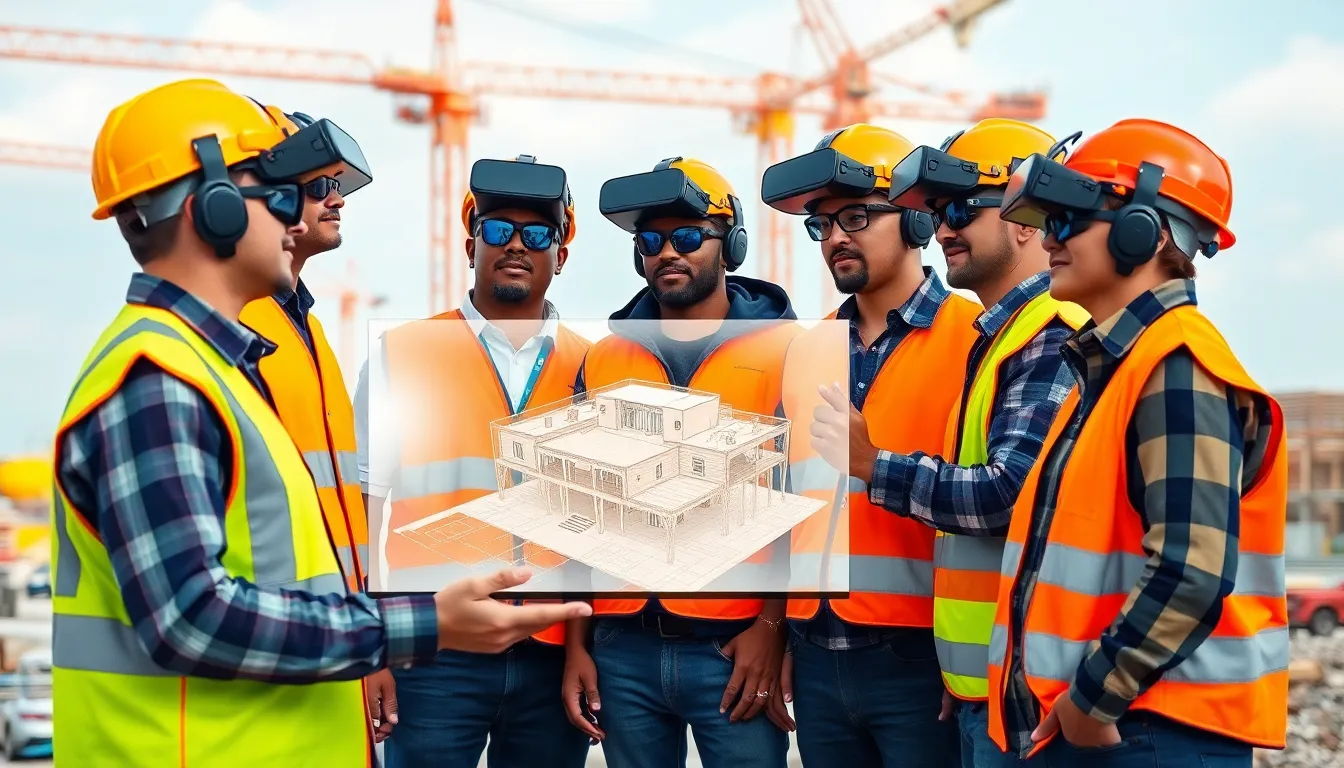
Imagine stepping onto a construction site where hard hats aren’t the only thing keeping you safe. With augmented and virtual reality, workers can now visualize projects before a single brick is laid. This tech isn’t just a flashy gimmick; it’s transforming how the construction industry operates, making it more efficient and, dare we say, a lot more fun.
AR VR in Construction
Augmented reality (AR) and virtual reality (VR) significantly enhance various aspects of the construction industry. These technologies make it possible for stakeholders to visualize projects before any physical work begins. As a result, teams can identify potential issues early, reducing costly errors later in the build process.
AR overlays digital information onto real-world environments, allowing on-site workers to see plans directly in their physical context. This capability improves safety by offering real-time guidance and hazard identification. Comprehensive training simulations in VR enable workers to experience environments and scenarios without real-world risks, fostering better preparedness.
Contractors increasingly utilize AR and VR for client presentations, showcasing designs through immersive experiences. Clients can walk through virtual models, gaining a better understanding of spaces and making informed decisions quickly. Enhanced communication among team members is another crucial benefit, as AR allows for shared insights and visual collaboration from different locations.
Statistical data supports the growing integration of these technologies. A study found that implementing AR and VR can enhance productivity by 25 percent and reduce project time by 15 percent. With continuous advancements, companies investing in AR and VR solutions remain competitive, driving innovation throughout the industry.
Adopting AR and VR transforms traditional construction methods, leading to higher efficiency and better project outcomes. Firms that embrace these technologies position themselves at the forefront of industry evolution, establishing a strong foothold in a rapidly changing environment.
Benefits of AR VR in Construction
AR and VR technologies offer significant advantages that transform construction practices.
Enhanced Visualization
Workers gain an improved understanding of project layouts through AR and VR. Augmented reality overlays digital designs onto physical sites, making it easier to see how components will fit together. Virtual reality creates immersive experiences, allowing teams to walk through a project before it begins. This capability minimizes misunderstandings, as employees clearly visualize the plans. Clients also appreciate the detailed representations, which aid in making informed decisions. Visual clarity reduces costly errors during construction, ultimately enhancing the overall workflow.
Improved Collaboration
Collaboration among team members improves greatly with AR and VR. These technologies enable real-time sharing of designs and updates, ensuring everyone stays on the same page. Workers can access 3D models and simulations from various locations, facilitating discussions regardless of physical distance. Multi-user capabilities allow multiple stakeholders to interact within the same virtual environment. Enhanced communication leads to more effective problem-solving, reducing the overall time spent on decisions. Teams can collaborate continuously rather than waiting for in-person meetings, streamlining the construction process.
Increased Efficiency
Efficiency levels rise significantly when incorporating AR and VR into construction. Data indicates that these technologies can boost productivity by up to 25 percent. Rapid identification of potential conflicts minimizes delays during the project lifecycle. VR training simulations prepare workers thoroughly, reducing mistakes on-site. On average, project timelines can shorten by as much as 15 percent. Construction firms that adopt AR and VR enhance their competitive edge by leveraging innovative solutions, ultimately positioning themselves as industry leaders.
Challenges of Implementing AR VR in Construction
AR and VR, despite their potential, face several challenges in construction. These hurdles can impede effective adoption and utilization.
Technical Limitations
Technical limitations pose significant challenges for AR and VR in construction contexts. Hardware and software must meet high performance standards for immersive experiences. In addition, compatibility issues with existing systems often arise. Users may encounter difficulties integrating these technologies into established workflows, creating setbacks in implementation. Moreover, training staff to effectively use AR and VR tools requires time and resources. Potential connectivity issues can disrupt performance on job sites, reducing efficacy. Addressing these technical constraints is essential for maximizing the benefits AR and VR offer to the industry.
Cost Considerations
Cost considerations significantly impact the implementation of AR and VR technologies in construction. Initial investments in hardware, software, and training can be substantial. Firms may hesitate to allocate budgetary resources to these emerging technologies. Long-term return on investment depends on improved productivity and reduced project timelines. However, quantifying these benefits can prove challenging. Smaller companies often struggle to afford cutting-edge solutions, widening the gap between industry leaders and challengers. Careful financial planning and evaluation are necessary to ensure sustainable integration of AR and VR technologies into construction practices.
Case Studies of AR VR in Construction
Companies across the construction industry are adopting AR and VR technologies to enhance project outcomes. One notable example is Turner Construction, which integrated AR for on-site visualization. By using AR goggles, workers view project plans overlaid on the actual site. This method helps catch potential errors early, saving time and resources.
Another significant case is the use of VR by Skanska for training purposes. Workers participate in immersive training scenarios that replicate real-world situations. This approach reduces risks associated with on-site training, boosting worker confidence and preparedness.
A third example involves the collaboration between Mortenson and Autodesk. They utilized AR for communication with clients during design phases. The immersive experience allows clients to interact with designs, leading to quicker feedback and fewer misunderstandings.
The construction company Civeo implemented a mixed-reality solution that combines AR and VR. By doing so, they improve remote collaboration among teams. Workers at different locations can share real-time data, enhancing decision-making processes.
Data from multiple sources indicate that these technologies lead to substantial productivity boosts. Projects experience a 25 percent increase in productivity and a 15 percent reduction in overall project time. These statistics highlight the importance of AR and VR in modern construction practices.
Despite the clear benefits, challenges remain. Technical limitations and training requirements can delay implementation. Smaller companies can struggle with initial investment costs, which may hinder widespread adoption. Nonetheless, the examples demonstrate the significant progress being made in integrating these technologies into construction workflows.
Future Trends in AR VR in Construction
Advancements in AR and VR technology continue to shape the construction industry. Enhanced visualizations are becoming even more sophisticated, allowing for detailed representations that assist in project planning. Companies are focusing on integrating AR and VR tools directly into their workflows, ensuring seamless communication and collaboration among teams.
Rapid developments in hardware are improving the accessibility of AR and VR. Devices are becoming lighter, more affordable, and easier to use, thereby increasing adoption rates among construction firms. Moreover, cloud technology is facilitating real-time updates and data sharing, which makes remote collaboration more efficient.
AI and machine learning integration are also emerging trends in this sector. These technologies can analyze project data, predict potential risks, and suggest solutions, allowing firms to address issues proactively. As these tools mature, firms will experience a shift towards data-driven decision making.
Visualization tools are increasingly being tailored for specific construction tasks. Customizable AR applications, for example, allow workers to receive alerts about safety hazards based on their immediate surroundings. Such innovations minimize risks and enhance overall site safety.
Sustainability practices are gaining importance in the construction industry as well. VR simulations can help evaluate environmental impacts, enabling firms to create greener projects. These efforts not only align with regulatory guidelines but also appeal to clients increasingly concerned about sustainability.
Statistics reveal a growing trend: AR and VR adoption could lead to productivity boosts of up to 25 percent and a reduction in project timelines by 15 percent. Firms that leverage these technologies will position themselves for significant competitive advantages in the marketplace. Through continued innovation, AR and VR are set to redefine construction methodologies in the coming years.
Conclusion
The integration of AR and VR in construction is undeniably reshaping the industry landscape. These technologies not only enhance safety and efficiency but also foster collaboration and communication among teams. As firms navigate the challenges of implementation, the long-term benefits become increasingly clear.
With advancements in hardware and software, AR and VR are becoming more accessible and user-friendly. This evolution positions construction companies to leverage these tools for improved project outcomes and competitive advantages. As the industry embraces these innovations, the future looks promising for enhanced productivity and sustainable practices. The transformative power of AR and VR is set to redefine how construction projects are visualized and executed.